

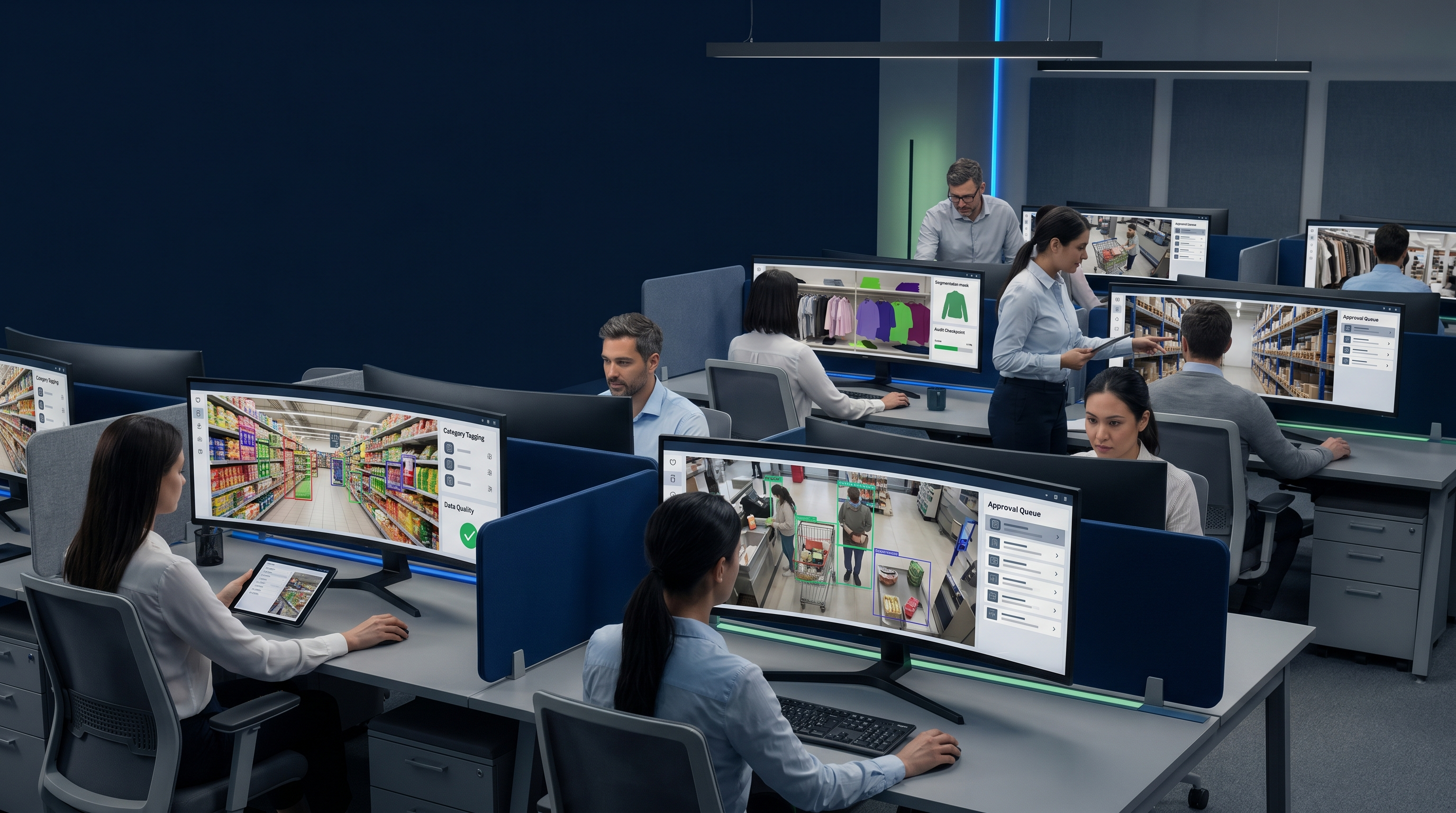
A retail image can contain dozens of products, partial labels, reflections, occlusions, promotions, variants and packaging that changes by region. The box is the visible part of the work. The judgement behind the box is the real system.
Competitor guides explain label types. Retail teams need label governance
Scale and iMerit have useful guides on computer vision labelling. They explain bounding boxes, polygons, segmentation and the connection between labels and model performance. That is necessary, but it is not enough for retail.
Retail annotation has a moving taxonomy. The same product may appear in old packaging, new packaging, multipack format, promotional wrap or local-language variant. Some shelves mix brands, private labels and substitutes. A simple instruction like "box every product" becomes fragile unless the taxonomy is versioned and reviewers know when to escalate an ambiguous item.
In SBL's retail computer vision case, the operating challenge was not only volume. It was keeping 3.5M+ annotated images consistent across trained annotators, quality reviewers and changing visual conditions.
The hardest error is a consistent wrong rule
A random miss is visible in sampling. A consistent wrong rule can pass sampling because every reviewer has learned the same mistaken interpretation. In retail, that might mean treating promotional packaging as a different SKU, ignoring partially visible shelf-edge items, or boxing a product family instead of the sellable unit.
This is why QA needs more than acceptance sampling. It needs disagreement analysis, guideline updates, reviewer calibration and feedback into the annotation workforce. CloudFactory's annotation guidance is right that guidelines act as reference documentation and knowledge transfer. The missing piece is making guideline drift visible as the project runs.
Retail model teams should ask vendors for a taxonomy change log, reviewer agreement rates and examples of corrected edge cases. A final accuracy number without those artefacts is hard to trust.
QA should be designed around model failure modes
If the model will be used for planogram compliance, annotation must be strict about shelf position and facings. If it will be used for checkout recognition, occlusion and scan angle matter more. If it will be used for inventory detection, partial visibility and empty-space rules matter.
The annotation workflow should therefore start from the model's decision, not from a generic label menu. Bounding boxes, segmentation masks and category tags are only useful when they match what the downstream model has to decide.
That is the operational gap in much public content. It teaches annotation formats as if the format is the work. In production, the work is translating a commercial decision into a repeatable labelling rule.
The vendor evidence that matters
A serious retail annotation programme should leave behind more than labelled files. It should leave behind guidelines, taxonomy versions, reviewer logs, exception categories, calibration notes and QA dashboards.
Those artefacts make the training data explainable. When model performance drops after a packaging change, the team can trace whether the problem came from data collection, label instruction, reviewer interpretation or model drift.
That is the standard retail teams should demand. Not just "we can label at scale", but "we can prove how the labels stayed consistent while the retail world changed".
Questions teams ask before they start
What makes retail computer vision annotation difficult?
Retail scenes contain many similar products, changing packaging, occlusion, reflections, shelf-edge ambiguity and regional product variants.
What QA evidence should buyers ask for?
Ask for taxonomy versions, reviewer agreement, sampling method, edge-case logs, calibration cadence and corrected examples.
Is automation enough for retail annotation?
Automation helps with throughput, but human review remains important where SKU ambiguity, packaging changes and edge cases affect model training.